
Read the Valley County Property Tax Record
Valley County property tax records pull together two sides of one story: what a parcel is worth and what it owes. The Assessor keeps the parcel and valuation record. The Treasurer sends statements, takes payment, and tracks balances. You can search Valley County property records by address or parcel number, then line up the assessment year, tax code area, exemptions, and payment status in one view. That comparison helps an owner of record question a bill, document a value change, file for an exemption, or weigh an assessment review.
| Field | What It Shows | Where |
|---|---|---|
| Land, dwelling and total value | Assessment components for the parcel and year | Valley County Assessor Map |
| Prior values and change | Earlier totals and a recorded change description | Valley County Assessor Map |
| Exemption | Qualifying owner-occupied relief claimed for the parcel | Assessor |
| Statement and balance | Tax charged, installments, payment and delinquency status | Valley County Treasurer |
| Tax code area and levy | Districts whose levies contribute to the charge | Treasurer tax-information map |
Idaho law treats assessment as full market value minus any exemptions. A tax record is still not a sale appraisal. A recorded deed, an assessment, and a tax bill answer three separate questions. Mixing them invites error. The Idaho State Tax Commission guide walks through how valuation, exemptions, and districts fit together. It also explains the Board of Equalization statewide.
Search Valley County Assessment Fields
The Valley County Assessor Map takes several entry points. Search by address, location or business. A parcel number works too. So does either owner field, a subdivision plat, or a point of interest. Partial address matching helps when a road name gets spelled two ways. Before reading the money fields, confirm the right candidate through its situs and legal description.
| Search source | Useful entry | Check after opening |
|---|---|---|
| Address | Street number and road name | Situs and parcel number |
| Parcel No. | Full parcel identifier | Legal description and parent parcel |
| Owner 1 / Owner 2 | Name spelling on the roll | Mailing display and situs |
| Subdivision Plats | Subdivision and phase | Lot, block, book and page |
Write down the visible tax year beside every amount. Map layers redraw over time, so an undated figure is weak evidence of a past assessment.
Why Valley County Values Change by Year
The parcel schema splits land, dwelling, and total values into current and prior columns. A change description rides along with them. The official sample shows a January 1, 2026 value date plus a revaluation notation. Two people can quote honest, different numbers for the same parcel simply because they pulled different assessment years.
- Assessed value
- The Assessor's value for the stated year.
- Market value
- The value concept Idaho assessors seek to reflect, not a sale guarantee.
- Tax charge
- The Treasurer's amount after applicable levies and exemptions.
- Sale consideration
- A transfer figure to check against the recorded instrument.
For a wider comparison, try the Valley County property value guide. This section stays on assessment and collection.
File a Valley County Homeowner Exemption
The county's homeowner exemption form asks for the parcel and residence, identification, vehicle or voter information, other property held, and certifications under Idaho Code section 63-602G. It is an application, not an appeal. File it only when the property and occupancy facts meet current rules. The county form shows the real application surface and the certifications it requires.
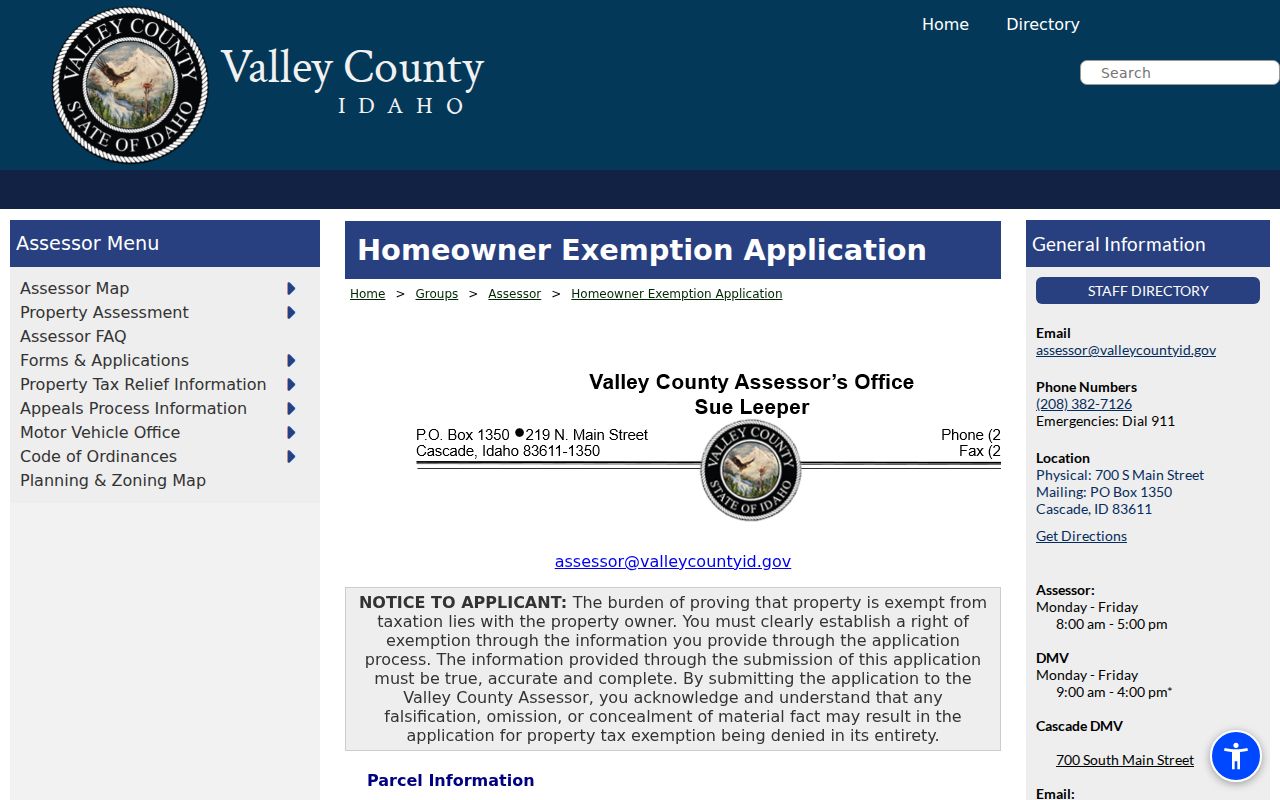
The exemption ties relief to one parcel. It changes no title and proves no open-market price.
Look Up a Valley County Tax Bill
Start with the parcel identity. Then go to the tax collector. The Valley County Treasurer links its tax-information map, levy material, and payment service, keeping the assessment source separate from the account that receives the money.
- Confirm the address and parcel number in the Assessor map.
- Open the official Treasurer route and match that parcel to its statement.
- Read the year, installments, amount paid, balance, and tax code area.
- Return to the assessment record to check values and exemptions.
- Ask the Treasurer directly about delinquency; no public tax-sale calendar was located.
- Assessed value
- The recorded annual value in the property-tax system.
- Levy
- A taxing district's rate contribution to the final charge.
- Homeowner exemption
- Qualifying relief claimed through the Assessor.
- Tax lien
- A public claim arising from unpaid property tax that needs official confirmation.
Per the Treasurer FAQ, statements go out by the fourth Monday in November. The first half is due December 20. The second half is due June 20. A statement that never arrives still creates an obligation. Pay through the official online payment portal, at the courthouse, or by mail. The Treasurer page serves as the county's routing point for tax information.
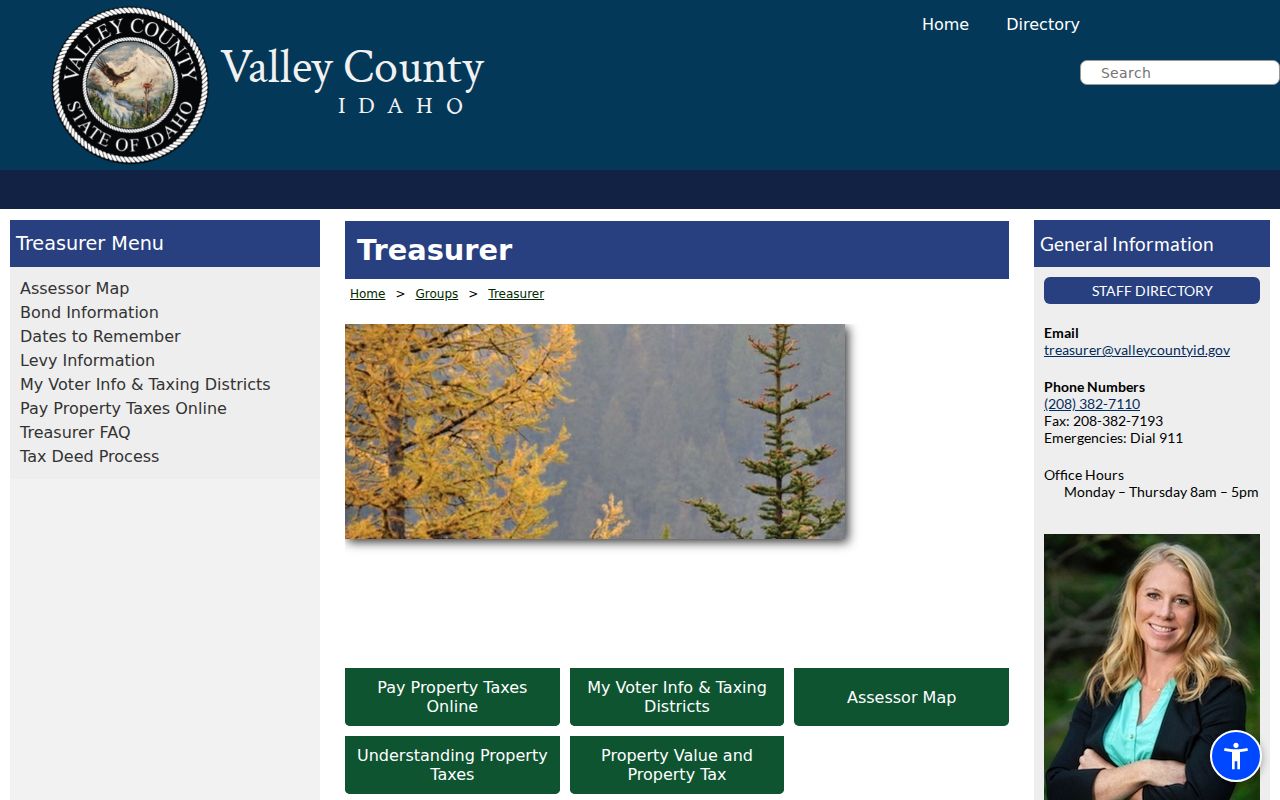
Use the Assessor parcel number to reduce the risk of opening a similar address.
Follow Valley County Tax Code Areas
A tax code area bundles every taxing district attached to a parcel. The Treasurer posts levy information for 2021 through 2025. Combinations shift across city limits, rural stretches, and service boundaries, so two parcels assessed alike can still carry different charges.
A bill is not title. A taxpayer or mailing display may differ from the legal owner, and the newest deed can lead the annual roll.
Request Valley County Property Tax Records Offline
When a portal fails, go to the source. The Treasurer handles statements and payment history. The Assessor handles values and parcel records. The county's public-record request form supports email, inspection, or copies. Keep the request narrow: parcel number, tax years, record type, preferred electronic delivery. Ask for a fee estimate before any broad copying, and confirm certified-copy fees or tax-sale dates with the custodian rather than a commercial listing.
Build a Valley County Tax Evidence Packet
A clean packet starts with the parcel number, situs, and legal description. Add the assessment year from the Assessor map. Add the land, dwelling, and total values, any prior-year comparison, the change description, exemption status, and tax code area. Include the Treasurer statement and payment status. Label every item with its source and access date. That discipline keeps one year's value from being paired with another year's charge.
When something looks wrong, first decide which office owns the disputed fact. The Assessor controls parcel and valuation data. The Treasurer controls statements, balances, installments, and payment. The Recorder holds the deed records, which may explain why an owner field shifted. A narrow request to the right custodian beats a broad sweep. A sweep pulls every file tied to an address.
Match Valley County Property Tax Dates
Each year in Valley County brings a handful of dates that mean different things. Map them out first. Several dates sit at separate points on the timeline. These include the assessment effective date, the notice date, the Board of Equalization window, the statement date, and the installment due dates. The statement arrives the fourth Monday in November. Installments come due December 20 and June 20. Those deadlines govern collection only.
They do not set when the assessed value takes effect. Office guidance can shift in a given year. Confirm the current Treasurer FAQ before relying on a due date. Questions about the assessment itself belong with the Assessor calendar and notice. County pages change over time. Keep the version or receipt you relied on. Dated copies matter most in certain cases. An exemption filing, ownership update, or recorded sale can land near a roll transition.
Check Valley County Property Tax Records Each Cycle
When a new cycle opens, pull the fresh parcel record. Set it beside the prior-year copy you saved. Compare the legal description, acreage, land value, dwelling value, total, exemption status, and change code. Also check the tax code area. Wait for the Treasurer statement. Only then treat a levy-based charge as final. After a sale, check the owner fields. See whether the mailing display has caught up with the recorded deed.
This side-by-side check catches identification errors early. That keeps them from spreading into a request or appeal. It also shows where a difference came from. The source may be valuation, an exemption, district geography, or plain collection timing. Keep copies of notices and office correspondence. Keep a tidy file with dates and parcel identifiers. That gives the Assessor or Treasurer a concrete question to answer.
Contest a Valley County Assessment
The Valley County appeal process starts informally, with a review by the Assessor. That conversation settles many disputes. If it does not, an owner may appeal to the County Board of Equalization. That appeal runs under Idaho's annual calendar. Before filing, weigh the notice against parcel facts, improvements, and value evidence. The deadline moves with the roll calendar. Trust the current notice over any older date.
Watch the current deadline. File within the window printed on the assessment notice and current calendar; a late challenge may miss that year's Board review.
The county page pictured below distinguishes informal review from the formal route.
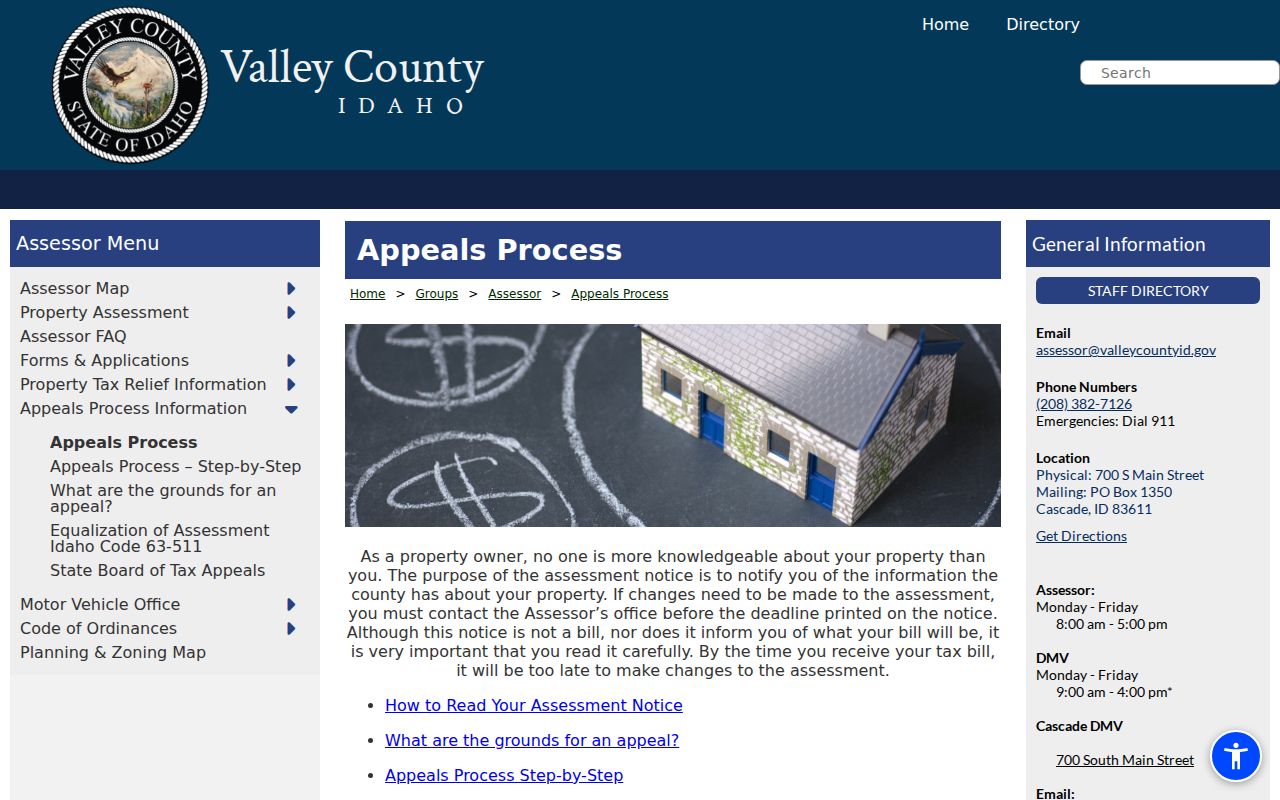
Save the submitted materials and receipt so a timely filing can be shown.