
Read Valley County Deed Records by Instrument Type
Deed records in Valley County cover the instruments accepted for recording. The Clerk, Auditor & Recorder handles that recording. A deed names the parties to a conveyance. It normally ties the transfer to a legal description. Mortgages, deeds of trust, releases, easements, plats, and restrictions sit in the same index. Each answers a different question. The county publishes no public document-type menu for this index. Treat these familiar categories as search clues rather than exact system labels.
| Deed Type | What It Does | Common Use |
|---|---|---|
| Warranty deed | Conveys the grantor's interest with stated covenants | Ordinary purchase trail |
| Quitclaim deed | Conveys whatever interest the grantor has, without the same covenants | Family or ownership cleanup |
| Special warranty deed | Limits warranties to the grantor's ownership period | Entity or negotiated transfer |
| Personal representative or trustee deed | Shows an authorized fiduciary conveying property | Estate or trust administration |
| Beneficiary or trustee instrument | May reflect deed-of-trust proceedings rather than an ordinary sale | Encumbrance or foreclosure research |
A deed transfers an interest. A lien or deed of trust burdens it. Searching only one side of that divide leaves a property history incomplete.
Start at Valley County's Tyler Recorder Index
The public Tyler document search is the online entrance to Valley County deed records. Index coverage begins January 1, 1966. The page also posts its own search-help syntax. Some result fields, image options, and fees sit behind a login. Treat the index as a locator, not the record itself.
The search supports exact terms and wildcards. You can require or exclude words, use single-character substitutes, and build phrases. Proximity expressions and grouping are supported too. Try a surname with first-name or initial variants. For an entity, strip the punctuation and test both short and long forms.
The Recorder Self Service disclaimer calls the catalogue a guide rather than the underlying record.
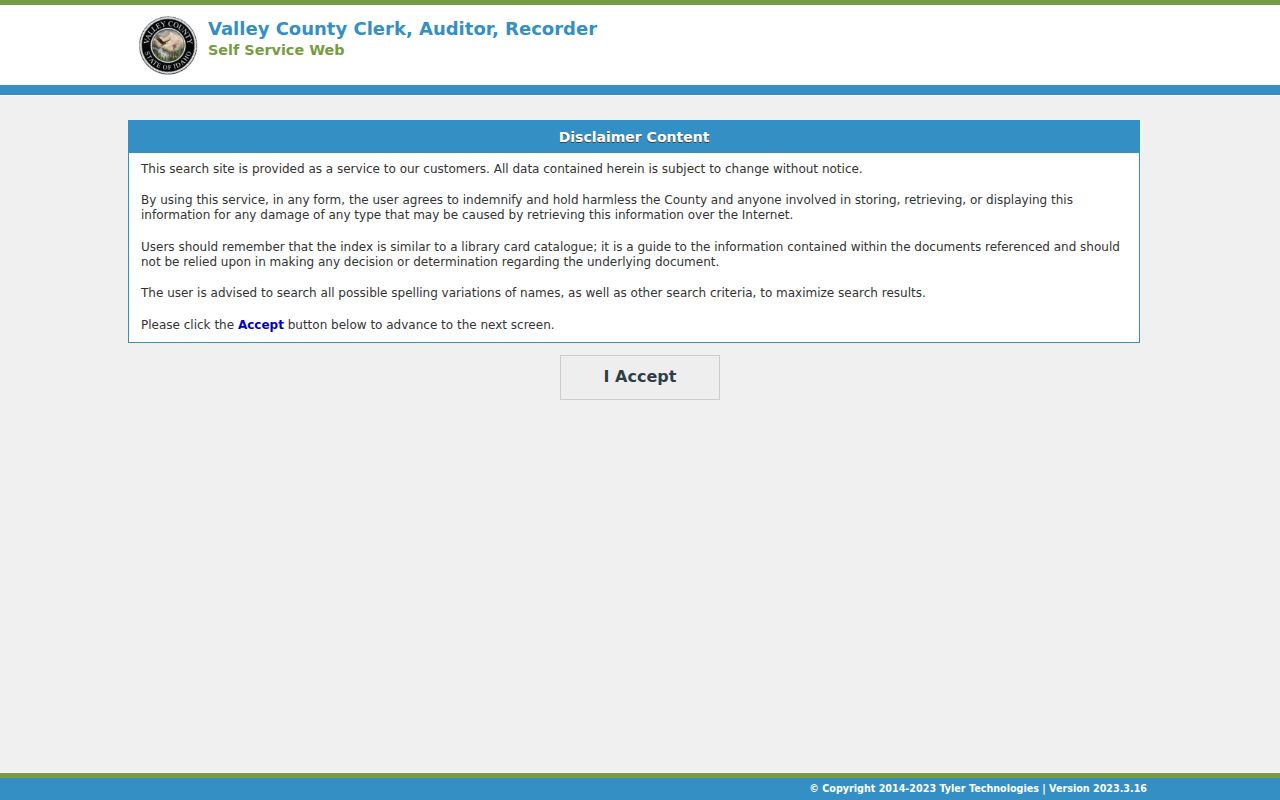
That distinction matters when an index abbreviation, a missing image, or a name variant could change the conclusion.
Use Names, Dates, and Legal Descriptions Together
| Search clue | How to use it | Why verify it |
|---|---|---|
| Grantor | Search the party transferring an interest | May reveal the prior link |
| Grantee | Search the party receiving an interest | Locates an acquisition deed |
| Recording date | Narrow a known transaction period | Execution and recording dates may differ |
| Instrument or book/page | Request the exact recorded item | Avoids same-name ambiguity |
| Legal description | Compare lot/block, subdivision, or PLSS text | Confirms the deed concerns the intended land |
Parcel numbers make useful crosswalks. But older deed records may rest on a legal description rather than a modern assessor number.
Walk the Valley County Grantor-Grantee Chain
Rebuild a chain of title link by link. Match each receiving party to whoever next conveyed the same property. Names alone will not carry the chain. Compare dates, legal descriptions, and document references at every step.
- Find the latest likely acquisition instrument with the present owner as grantee.
- Read its grantor and exact legal description.
- Search that grantor as an earlier grantee and compare the land description.
- Repeat until the chain reaches the 1966 online boundary, then continue through office-held books or microfilm.
- Grantor
- The party transferring the stated interest.
- Grantee
- The party receiving it.
- Chain of title
- The linked sequence of recorded transfers affecting the same land.
- Book/page or instrument number
- The citation used to identify a particular recording.
Connect Valley Plats, Easements, and Restrictions
The county's subdivision-plat layer lists subdivision name, year, book, page, instrument number, and a plat link. Those fields bridge a GIS map label to the recorded instrument. Search phase-name variants too. A planning title, a GIS subdivision name, and a recorded plat caption do not always match. Names drift. Trust the recorded plat caption over the planning title when they disagree.
Easements, covenants, road access, and common-area interests can bind a parcel without changing the tax-roll owner. The tax roll stays silent on them. Search the Recorder around the plat and deed references instead of assuming the deed text holds the full story. The deed text rarely tells the whole tale.
Continue Valley County Deeds Before 1966 Offline
January 1, 1966 is where the online index starts, not where the county's records end. Contact the Clerk, Auditor & Recorder at 219 N Main Street, PO Box 1350, Cascade, ID 83611, (208) 382-7100 option 2, Monday-Friday 8:00 a.m.-5:00 p.m. Ask for the deed-book, plat, or microfilm route with a narrow party and date range.
Historic place names can unlock a stalled search. Valley County was created in 1917. Cascade's six-block townsite dates to 1913, the railroad arrived in 1914, and the courthouse was built in 1929. Use the county chronology and historic newspapers for spelling and date leads, then prove the transfer in the recorded instrument.
Note: A newspaper, cemetery entry, or local history can identify a person, but it cannot establish ownership.
Check the Assessor Owner Against the Newest Deed
The Assessor Map shows OwnerName1 and OwnerName2. The county publishes no official statement of the deed-to-roll update lag. A freshly recorded conveyance can appear in deed records before the annual assessment roll catches up. Use the assessor parcel and legal description as identifiers. Then confirm the newest grantee in Tyler.
Tax charges and sale lines are leads. They are not substitutes for the conveyance. For general lookup mechanics, see the Valley County property search guide. This page stays with the recorded deed trail.
Distinguish Real-Estate Liens from Idaho UCC Filings
A deed of trust, release, or judgment belongs in the county land-record trail. Other recorded encumbrances belong there too. An Idaho UCC filing is a different animal. Search those through the Secretary of State UCC service. An LLC's organization record can decode a grantee name. Neither an entity record nor a UCC search replaces a Valley County deed search.
Litigation, probate, foreclosure, or quiet title can all reach the chain. Check the Idaho iCourt Portal in those cases. Request the actual court file from the clerk when necessary.
Obtain a Valley County Deed Copy from the Custodian
Start with the party names and the recording date. Add the instrument number or book/page, plus the legal description from Tyler. If no image is publicly available, reach the Recorder by phone. You can also email ValleyClerk@valleycountyid.gov, use mail, or visit the Cascade counter. The county posts no certified-copy fee sheet online. Say whether you need a plain electronic image or a certified copy. Ask for a current estimate before ordering.
The county's public-record request form works for a clearly described record. Ask for electronic delivery when practical. Keep the receipt and the response.
Recorded, not guaranteed. Valley County deed records show instruments accepted for recording. They do not resolve every unrecorded interest, lien priority, boundary conflict, or title defect.
Respond Carefully to Deed-Fraud Concerns
Valley County offers no official property-fraud alert enrollment. Do not expect one from any vendor either. A concerned owner can check the Tyler index from time to time, keep copies of legitimate instruments, and call the Recorder about any unfamiliar entry. The county's public notice material includes privacy-incident and identity-theft guidance, but it is not a deed-monitoring service.
Suspected forgery needs professional advice. Contact the office directly. Preserve the document citation and pull the underlying image before drawing any conclusion about a recorded deed.
Preserve the Deed Search as an Evidence Trail
Keep a careful log of every deed search. Record the exact party spelling and the date range. Write down the Tyler query syntax, the document citation, and the legal description. Note the access date. When an image arrives, mark whether it is an informational copy or a certified copy from the custodian. This small log keeps a later researcher from confusing an index result with the recorded instrument, and it makes name-variant searches reproducible.
A parcel split can break the chain. Fix it with details. Add the parent and child parcel numbers, the plat book and page, and the subdivision phase. The map's change layers and the Recorder's legal-description trail can then be compared without assuming a modern parcel identifier sat on an older deed.
The online chain stops at January 1, 1966. Stop there and prepare a handoff. Take the last grantee, grantor, legal description, book or instrument reference, and approximate date to the Recorder. Ask which deed book, reverse index, plat book, or microfilm series continues the search. No complete online inventory is posted. Ask about access methods and fees before ordering. McCall and Cascade library material, digitized newspapers, and the Idaho State Archives can help identify earlier names and dates, but each transfer still needs a filed deed, probate order, affidavit, or other instrument.