
Trace Former Valley County Property Owners
No single roster lists former Valley County property owners. The chain is rebuilt from transfers. Start with the newest deed tied to the parcel's legal description. Name its grantor, then find the deed by which that grantor earlier acquired the same land. The Tyler Self Service index opens January 1, 1966. Earlier links may require the Clerk, Auditor & Recorder's deed books, plats, or microfilm, with library and archive sources serving only to generate names and dates for verification.
| Source | Years It Covers | Where Held | What It Shows |
|---|---|---|---|
| Tyler Recorder index | January 1, 1966 to present interface | Online or Recorder assistance | Grantor, grantee, instrument, date, and document lead |
| Older deed books and microfilm | Pre-1966; exact holdings not verified | Clerk, Auditor & Recorder | Earlier conveyances indexed by party or book |
| Recorded subdivision plats | Varies by plat | Recorder and county GIS plat links | Lot, block, phase, book/page, and parent geometry |
| Historic newspapers and collections | Located titles span 1915-2022 | Library and archive channels | Name and date clues that still require deed confirmation |
Tyler works well for the post-1966 chain. When an image is absent, the Recorder counter, phone, email, or mail route fills the gap. For an earlier link, bring the last verified grantee, deed date, and legal description to the office. Bring the book or instrument citation too. An assessor sales line never substitutes for the recorded transfer. Neither does a newspaper name.
The Valley County Recorder's public document search is the online starting point. It carries the grantor and grantee sequence.
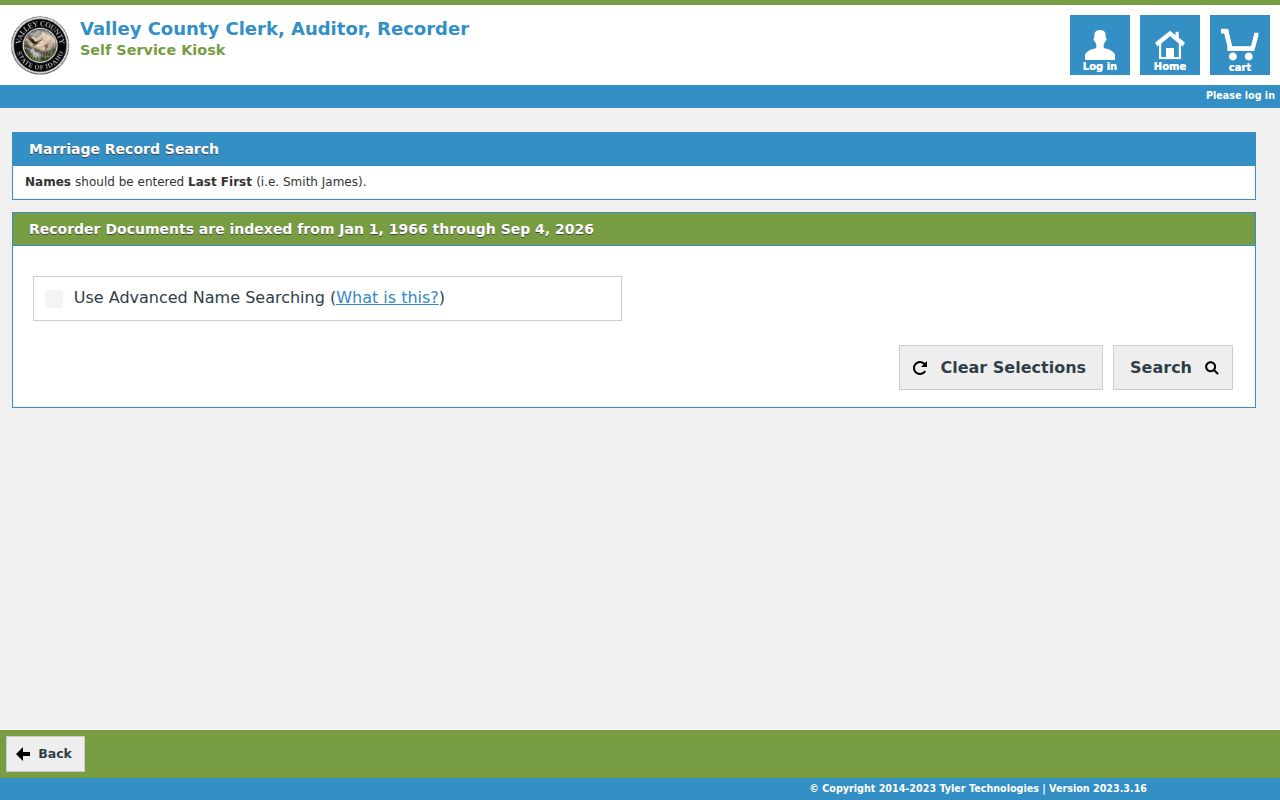
The interface supports the trail back to late 1965. Behind every index entry, the instrument image or a custodian copy supplies the evidence that makes the chain hold.
Walk the Valley County Deed Chain Backward
The backward method keeps the land fixed while the parties change. Begin with the current owner's acquiring deed. The assessor's recent-sales list is not a full history. At every step, match dates, document numbers, subdivision and phase, lot or block, acreage, legal text, and the exact land. A same name alone proves nothing.
- Find the current owner's acquisition instrument, with that owner shown as grantee.
- Read the grantor and exact legal description from that deed.
- Search the grantor as a grantee in an earlier conveyance and verify the same land.
- Repeat until January 1, 1966, then request the relevant older book or microfilm index.
- Grantor / grantee
- The party conveying an interest and the party receiving it.
- Chain of title
- The ordered sequence of instruments affecting the same land.
- Reverse index
- An index organized to help follow a party in the opposite role.
- Legal description
- The land description that remains useful when an address or parcel number changes.
Stop the Online Search at Valley County's Verified Boundary
The Recorder's online index starts January 1, 1966. That date marks the edge of the web search. It does not mean older records are missing. Once a chain crosses the boundary, contact the Valley County Clerk, Auditor & Recorder at 219 N Main Street in Cascade. Call (208) 382-7100 option 2. Email ValleyClerk@valleycountyid.gov. Mail also works: PO Box 1350, Cascade, ID 83611. Ask for the older index or volume using your most recent pre-cutoff clues. Request the format, cost estimate, and certification procedure from the custodian directly. County-listed office hours are Monday through Friday, 8:00 a.m. to 5:00 p.m.
Online cutoff. The web index begins in 1966; tracing earlier owners may require deed books or microfilm held by the Recorder.
Use the Legal Description to Survive Address Changes
Older deeds often skip the street address entirely. The address is a modern convenience, not a permanent identifier. For older work in Valley County property records, rely on the parcel's Legal1 through Legal3 fields. Also use the subdivision name, lot, block, acreage, and any section-township-range text. Parcel formats can look opaque. No official decoding legend exists. So avoid guessing at what each character means. Treat the number as a label rather than a formula.
Splits, merges, and parent-child transactions can also renumber a parcel. The county's map offers a 2025-to-2026 parcel-change layer plus a parent-parcel layer. When the ownership chain seems to stop, build a crosswalk first. List the old parcel, new parcel or parcels, parent parcel, recorded instrument, plat citation, and legal description. That paper trail usually shows the history continued under a new number.
Note: The legal description and recorded plat hold up far longer than a street label or a guessed parcel-number pattern.
Reconnect Valley County Former Owners Through Recorded Plats
Subdivision names can bridge the deed index and the county GIS map. Search the official SUBDIVNAME field. Preserve phase suffixes. Inspect lot, block, book, page, instrument number, and PlatLink values along the way. County data shows names like Spring Mountain Ranch, 19th Hole Estates, Allen's Cascade Addition, River District or Cascade River Ranch, Crane Shores, Pines by the Lake, Saddle Rock, and Shaw Family Ranch.
A plat fixes the recorded lot geometry. It does not show every conveyance. Follow the parent parcel into final lots. Then trace each lot through deeds. Amendments, vacations, common areas, easements, covenants, and later phases may add separate instruments, while Donnelly-area projects carry application numbers such as 22-30, 21-19, and 21-34 that can pinpoint the planning trail before the deed search resumes.
Bridge Estate Transfers Without Guessing at a Valley County Owner
A clean sale-to-sale sequence can be interrupted. Probate, an affidavit, a trustee instrument, a personal representative's deed, or a court order may sit between the sales. Search the Recorder by the decedent, the estate, the trust, the representative, and the later grantee. Idaho iCourt adds public case context where it fits. Sealed or exempt information will not appear.
Vital records sit at the state level and stay restricted for set periods. Birth records are closed for 100 years. Death, marriage, divorce, and stillbirth records stay closed for 50 years under Idaho Code §39-270, subject to qualifying access. An obituary can help separate similar names. Still, the recorded instrument or public court order must carry the ownership claim, not an identity clue.
Use Valley County Newspapers as a Time Map, Not a Deed Index
Old newspapers can pin down dates when the online deed record runs out. Valley County titles help here. Cascade News covers 1915 to 1967. Payette Lakes Star ran 1918 to 1967. Star-News covers 1967 to 2022, and Central Idaho Star 1977 to 1988. Look for spelling variants and estate notices. Also watch for road descriptions, subdivision promotions, and names tied to a parcel.
The University of Idaho Valley County history folder adds depth too. It spans 171 pages dated 1919 through 2016. The pages touch settlers, mining, ranching, logging, roads, recreation, and storms. Context like that can explain why one place shows up under several names. It still cannot replace a deed. Write down the clue. Go back to the legal description. Then ask the Recorder or archive for the matching instrument.
Keep a Valley County Ownership Timeline That Can Be Audited
A good chain log keeps track of every transfer. Log the date, grantor, grantee, deed type, instrument or book and page, legal description match, source URL or office, and image status. Flag uncertain links rather than quietly joining them. When a quitclaim deed shows up, record exactly what the instrument says and skip any assumption that it warrants good title.
| Transfer date | Grantor to grantee | Deed type | Book/page or instrument |
|---|---|---|---|
| Newest verified transfer | Copy names from instrument | Use recorded label | Save exact citation |
| Next earlier transfer | Prior grantor found as earlier grantee | Use recorded label | Match the same legal description |
| Pre-1966 link | Record-book parties | Use volume wording | Note book, page, and custodian |
That structure exposes gaps plainly. It also stops a limited assessor sales display from passing as a complete list of former owners.
Know How Far Valley County Ownership Research Can Go
The Recorder's online property records reach back to 1966. Beyond that, no complete deed-book or microfilm inventory is published. No earliest surviving deed year or documented records-loss cutoff is stated. Say so plainly. An older search depends on the Recorder's holdings and a usable legal description. It also depends on whatever book, page, plat, or party index survives for the period.
Federal patent or state archive material can supply an origin clue when a land chain predates county-era instruments. It must be matched forward into local conveyances. Library histories, newspapers, and cemetery or obituary evidence help identify names and dates. Never list someone as a former owner without cause. An instrument or court record must back the link.
Lawful use. Former-owner research supports house history, estate work, and property diligence. Never use ownership history to track, intimidate, harass, or harm a living person.